http://www.guardian.co.uk/film/2005/nov/10/france.world
http://www.criterion.com/current/posts/476-la-haine-kassovitz-vs-sarkozy
http://www.isj.org.uk/?id=156
http://www.bbc.co.uk/films/2004/08/04/la_haine_2004_review.shtml
http://seacoast.sunderland.ac.uk/~os0tmc/contemp1/lahaine.htm
http://www.acme-journal.org/vol6/ASi.pdf
http://www.bfi.org.uk/education/teaching/witm/recommended/lahaine.html
http://www.mhra.org.uk/ojs/index.php/wph/article/viewFile/56/50
This one summarises the film in shots:
http://evanerichards.com/2011/2011
http://www.leftfieldcinema.com/la-haine-review
http://www.dvdbeaver.com/film/dvdreviews5/hate.htm
http://www.filmeducation.org/pdf/film/LaHaine.pdf
http://www.criterion.com/current/posts/642-la-haine-and-after-arts-politics-and-the-banlieue
http://alsolikelife.com/shooting/2007/05/920-la-haine-hate-1995-matthieu-kassovitz/
http://www.slate.com/articles/arts/dvdextras/2005/11/la_haine.html
http://www.subtitledonline.com/reviews/la-haine-4
France in revolt: 1995-2005
Issue: 109
Posted on
Jim Wolfreys
‘In recent years,’ remarked the sociologist Emmanuel Todd in November 2005, ‘French political life has been nothing but a series of catastrophes. And each time the ruling class’s lack of legitimacy becomes more flagrant’.1 He was speaking in the aftermath of the rioting which had set dozens of France’s rundown suburbs ablaze for a full three weeks, providing an unrelenting nightly reminder of the anger felt by urban youth at years of impoverishment, discrimination and repression, and their frustration at the political establishment’s disregard for them and their neighbourhoods. If the 8,000 cars torched during the uprising spoke of the lack of more effective political tools at their disposal, then the government’s response, exhuming emergency powers from France’s colonial past, was an eloquent indication that the options open to a regime in crisis were narrowing after a decade of revolt against social inequality.
Jacques Chirac’s 1995 presidential election victory had been based on a promise to heal France’s ‘fracture sociale’, a phrase borrowed from a report on social exclusion written by Todd himself. But it soon became clear that the Gaullists’ vision of a ‘France for all’ amounted to the same neo-liberal free for all served up by governments of left and right since the early 1980s. Within six months of Chirac’s victory his prime minister, Alain Juppé, had produced a plan designed to overhaul the social security and pensions system established in the aftermath of the Second World War.
The response of the labour movement to Juppé’s offensive was nothing short of astonishing. On 24 November railway workers went on strike, groups of them going into sorting offices to call on postal workers to do the same. As the strike gained momentum, they in turn urged telecom workers to follow, who were then joined by those in the electricity and gas industries, along with hospital staff. With the movement driven largely from below and organised through mass meetings of strikers ‘all together’, irrespective of sectional or union affiliations, demonstrations in support of the strikes were held on an almost daily basis until mid-December, mobilising 2 million people nationally at their peak. By 15 December the government had withdrawn its pension reforms. Although the government was still able to push through the cuts in social security, Juppé never recovered from the strikes. His administration stumbled on for a further 18 months and then the man generally expected to assume the leadership of the mainstream right after Chirac simply drifted into obscurity.
November/December 1995 was a turning point, not just in France but internationally. It marked the end of a long cycle of defeats for the labour movement, and the beginning of an ongoing period of resistance to neo-liberalism which has found expression in a series of anti-capitalist protests, beginning in Seattle in November 1999, and in the development of a critique of contemporary capitalism that traditional social democratic parties were no longer capable of providing.
This article is about what has happened to the movement in France during the ten years since 1995. It begins with an assessment of the crisis facing a ruling elite whose parties and institutions are no longer capable of mobilising mass popular support for its policies, before looking at the potential—and the limitations—of a movement which has proved capable of resisting the establishment, but has not yet been able to offer a viable alternative to it.
‘In recent years,’ remarked the sociologist Emmanuel Todd in November 2005, ‘French political life has been nothing but a series of catastrophes. And each time the ruling class’s lack of legitimacy becomes more flagrant’.1 He was speaking in the aftermath of the rioting which had set dozens of France’s rundown suburbs ablaze for a full three weeks, providing an unrelenting nightly reminder of the anger felt by urban youth at years of impoverishment, discrimination and repression, and their frustration at the political establishment’s disregard for them and their neighbourhoods. If the 8,000 cars torched during the uprising spoke of the lack of more effective political tools at their disposal, then the government’s response, exhuming emergency powers from France’s colonial past, was an eloquent indication that the options open to a regime in crisis were narrowing after a decade of revolt against social inequality.
Jacques Chirac’s 1995 presidential election victory had been based on a promise to heal France’s ‘fracture sociale’, a phrase borrowed from a report on social exclusion written by Todd himself. But it soon became clear that the Gaullists’ vision of a ‘France for all’ amounted to the same neo-liberal free for all served up by governments of left and right since the early 1980s. Within six months of Chirac’s victory his prime minister, Alain Juppé, had produced a plan designed to overhaul the social security and pensions system established in the aftermath of the Second World War.
The response of the labour movement to Juppé’s offensive was nothing short of astonishing. On 24 November railway workers went on strike, groups of them going into sorting offices to call on postal workers to do the same. As the strike gained momentum, they in turn urged telecom workers to follow, who were then joined by those in the electricity and gas industries, along with hospital staff. With the movement driven largely from below and organised through mass meetings of strikers ‘all together’, irrespective of sectional or union affiliations, demonstrations in support of the strikes were held on an almost daily basis until mid-December, mobilising 2 million people nationally at their peak. By 15 December the government had withdrawn its pension reforms. Although the government was still able to push through the cuts in social security, Juppé never recovered from the strikes. His administration stumbled on for a further 18 months and then the man generally expected to assume the leadership of the mainstream right after Chirac simply drifted into obscurity.
November/December 1995 was a turning point, not just in France but internationally. It marked the end of a long cycle of defeats for the labour movement, and the beginning of an ongoing period of resistance to neo-liberalism which has found expression in a series of anti-capitalist protests, beginning in Seattle in November 1999, and in the development of a critique of contemporary capitalism that traditional social democratic parties were no longer capable of providing.
This article is about what has happened to the movement in France during the ten years since 1995. It begins with an assessment of the crisis facing a ruling elite whose parties and institutions are no longer capable of mobilising mass popular support for its policies, before looking at the potential—and the limitations—of a movement which has proved capable of resisting the establishment, but has not yet been able to offer a viable alternative to it.
The bitterest pill
During the 1980s France’s two main political parties, the Socialists and the Gaullist RPR, adopted the neo-liberal policy model pioneered in Britain and the US. But resistance proved hard to break down. University students, nurses, and railway and bank workers fought back in the late 1980s, as did school students, and Air France and France Telecom workers in the early 1990s. This resilience combined with a broader political identification with certain aspects of the so-called ‘Republican social model’, based on the establishment and consolidation of the welfare state in the immediate post-war period. As a result no party was able to mobilise widespread support for ‘popular capitalism’ and dominate French political life sufficiently to achieve the comprehensive imposition of neo-liberal reforms demanded by employers. Indeed, no government has been able to win a second term in France for nearly 30 years.
The cross-party consensus that there is no alternative to an unbridled market economy has progressively alienated every mainstream party from its activist base and electorate. The historic Socialist election victory of 1981, which put an end to 23 years of right wing rule, was followed by ‘alternation’, whereby parties of left and right take turns in office. This was held up as a sign of the ‘maturity’ of the political institutions of the Fifth Republic.
But these institutions are now in crisis. Alternation pits parties against each other, but since the intensification of competition between the major parties is no longer primarily based on ideological differences it takes other forms, most of which tend to erode further the legitimacy of these parties. Networks of corruption became increasingly necessary to underpin the operations of declining organisations. For much of the post-war period collusion between the major parties, intent on freezing the Communists out of government, had kept corruption ‘in-house’. But deeper internal divisions, and the decline of the Communist ‘threat’, meant that whistleblowing was increasingly used as a means of undermining opponents and rivals. Revelations from within the RPR, for example, have made it an open secret that the Paris city hall was turned into an elaborate slush fund for the party over a 20-year period following Chirac’s election as mayor in 1977, while various leading Socialists, along with prominent figures in both mainstream right wing parties, have been forced to resign their posts following dozens of high profile trials and scandals.
By 1995 internal rivalry within the RPR had reached such a pitch that Chirac’s position as the uncontested figurehead of the party was challenged by his prime minister Edouard Balladur, who managed to group the most committed neo-liberal elements of the mainstream right, like Alain Madelin and Nicolas Sarkozy, around his campaign. Chirac was reduced to standing on a ‘social’ platform that implicitly rejected the very neo-liberal model he himself had convinced the mainstream right to adopt in the 1980s. Two years later Lionel Jospin, a key figure in persuading Socialist Party activists to abandon plans for sweeping social reform in the 1980s, performed a similar trick to become prime minister. He placed himself at the head of a ‘plural left’ coalition with the Communists and Greens, and promised to turn the demands of the so-called ‘social movement’ into policy. The response by the CNPF employers’ association was aggressive. Its outgoing president, Jean Gandois, emerged white with anger from a meeting at which Jospin had made plain his government’s intention to honour its commitment to a 35-hour week. ‘We have been duped,’ he claimed, and called on his successor to be ‘a killer’. The association duly changed its name from a onfederation to a ‘movement’ (MEDEF),2 and proceeded to fight a long, and largely successful, campaign to undermine the 35-hour week.
By 1998 frustration at the pace of neo-liberal counter-reform led several leading ruling class figures openly to advocate electoral alliances between the mainstream right and the fascist Front National. Such was the extent of political polarisation in France that four years later Jean-Marie Le Pen was able to beat Jospin into third place in the presidential election all on his own, going through to a second round standoff against Chirac. The Socialist Party, with only symbolic reforms to compensate for mass unemployment and the privatisation of public services on an unprecedented scale, had failed for the first time to achieve the objective which had inspired its formation in 1972—to compete for the presidency. Alternation was in disarray, and Chirac posed as the champion of ‘the Republic in danger’ after getting the first round support of under 14 percent of registered voters. The millions who flocked to demonstrate against Le Pen summed up the meagre choice before them with the slogan, ‘Rather the crook than the fascist.’
There was basic continuity between Jospin and Juppé on economic and social policy. But there was a significant difference between the ability of the ruling elite to set the agenda in France and elsewhere. The difference was confirmed by the introduction of a 35-hour week, although it brought little significant change to most working lives (one study estimates that it has reduced total working hours by around 3 percent),3 by the scale of opposition to its attacks on the education system and by the waves of protest involving various networks and associations of the social movement. Francis Fukuyama expressed the concern of the elites internationally:
The United States and Great Britain had Ronald Reagan and Margaret Thatcher. Both broke the old order and laid the basis for new growth. The following generation saw the arrival of Bill Clinton and Tony Blair. Fundamentally, they applied the same economic and social recipes, under a left guise. Nothing of the sort has ever happened in France… France’s handicap is that it has not yet found an actor or a party which will subject it to this cathartic exercise.4
Desperately seeking such an actor, Chirac turned to the unlikely figure of Jean-Pierre Raffarin, a portly notable from the west of France with no outward signs of personality or charm, whose rather unimaginative advisers presented him as the embodiment of ‘the France from below’. Raffarin, like Chirac and Jospin before him, found that pretending to be something he was not could only get him so far. He emerged victorious in the summer of 2003
from a hard fought struggle by public sector workers to ward off his attacks on their pension rights, famously declaring, ‘It’s not the street that governs.’ But the extent of popular opposition to neo-liberalism proved fatal to him two years later. He became the scapegoat for the political establishment’s failure to persuade a simple majority of the population to back the proposed neo-liberal constitution for the EU in the May 2005 referendum.
The weakness of the regime was clearly exposed. After defying the street in 2003, Chirac was now faced with the choice of disregarding the ballot box or standing down. Since nobody was forcing him to stand down he found a new prime minister, Dominique de Villepin, an ally and a lifelong stranger to elected office, and a new interior minister, Nicolas Sarkozy, a rival whose contempt for Chiraquism was undisguised. ‘It is no longer the Paris city hall,’ Sarkozy had declared in 1995. ‘It’s the antechamber of the morgue—Chirac is dead, all that’s missing are the last shovels of earth’.5 The composition of the government—with Sarkozy shadowing De Villepin and the centre-right UDF coalition refusing to take ministerial office—was a vivid reflection of longstanding divisions within the ruling class over how hard and how fast to push the neo-liberal offensive. The difficulties experienced by successive governments in asserting a neo-liberal agenda lay with the Republican social model, according to the hardline conservative right:
The blockage of the state and the political sphere is directly related to the hard core of the ruling class under the Fifth Republic, which is based on osmosis between political leaders, top civil servants and the union leaders. From this comes a consensus, which goes beyond political cleavages, in favour of retaining a social-state model.6
Sarkozy has no qualms about denigrating this model when he feels it necessary to do so. He departed from the Gaullist party line at the height of the referendum campaign to declare, ‘The best social model is the one which gives everyone a job. So it’s no longer ours!’7 And just as George Bush can leave New Orleans to its fate while heaping praise on Rosa Parks and the civil rights movement, so Sarkozy can denounce France’s urban youth as a ‘dirty rabble’ whose neighbourhoods should be cleaned out with a power hose, and at the same time propose abandoning the allegedly ‘colour blind’ Republican model of integration in favour of ethnic monitoring, affirmative action and voting rights for immigrants. Sarkozy represents, for sections of the French right, Fukuyama’s missing link in French politics, the neo-liberal enforcer. Members of his entourage make no bones about what their desire for ‘a right without complexes’ represents:
I’ve always been conservative. I like order. I believe in individual initiative and effort and, where the economy is concerned, in the invisible hand of the market. For example, I’m for the total privatisation of the state education system.8
Sarkozy may receive standing ovations when addressing the MEDEF, but his political base on the right is much narrower than that enjoyed by Juppé a decade ago, and the right’s level of support nationally far lower than it was then. And yet, following its humiliating defeat in the EU referendum, the government was still able to announce the privatisation of the motorways and the closure of unprofitable railway lines, and to impose a new ‘employee contract’ by decree. This gave employers, for the first time, the right to sack workers during the first two years of their contract without any justification.
How then, given the chronic weaknesses of the French right, and
the apparent strength of the ‘social movement’ since 1995, has it been possible for such measures to be implemented along with other similar attacks, notably on pensions and social security?
During the 1980s France’s two main political parties, the Socialists and the Gaullist RPR, adopted the neo-liberal policy model pioneered in Britain and the US. But resistance proved hard to break down. University students, nurses, and railway and bank workers fought back in the late 1980s, as did school students, and Air France and France Telecom workers in the early 1990s. This resilience combined with a broader political identification with certain aspects of the so-called ‘Republican social model’, based on the establishment and consolidation of the welfare state in the immediate post-war period. As a result no party was able to mobilise widespread support for ‘popular capitalism’ and dominate French political life sufficiently to achieve the comprehensive imposition of neo-liberal reforms demanded by employers. Indeed, no government has been able to win a second term in France for nearly 30 years.
The cross-party consensus that there is no alternative to an unbridled market economy has progressively alienated every mainstream party from its activist base and electorate. The historic Socialist election victory of 1981, which put an end to 23 years of right wing rule, was followed by ‘alternation’, whereby parties of left and right take turns in office. This was held up as a sign of the ‘maturity’ of the political institutions of the Fifth Republic.
But these institutions are now in crisis. Alternation pits parties against each other, but since the intensification of competition between the major parties is no longer primarily based on ideological differences it takes other forms, most of which tend to erode further the legitimacy of these parties. Networks of corruption became increasingly necessary to underpin the operations of declining organisations. For much of the post-war period collusion between the major parties, intent on freezing the Communists out of government, had kept corruption ‘in-house’. But deeper internal divisions, and the decline of the Communist ‘threat’, meant that whistleblowing was increasingly used as a means of undermining opponents and rivals. Revelations from within the RPR, for example, have made it an open secret that the Paris city hall was turned into an elaborate slush fund for the party over a 20-year period following Chirac’s election as mayor in 1977, while various leading Socialists, along with prominent figures in both mainstream right wing parties, have been forced to resign their posts following dozens of high profile trials and scandals.
By 1995 internal rivalry within the RPR had reached such a pitch that Chirac’s position as the uncontested figurehead of the party was challenged by his prime minister Edouard Balladur, who managed to group the most committed neo-liberal elements of the mainstream right, like Alain Madelin and Nicolas Sarkozy, around his campaign. Chirac was reduced to standing on a ‘social’ platform that implicitly rejected the very neo-liberal model he himself had convinced the mainstream right to adopt in the 1980s. Two years later Lionel Jospin, a key figure in persuading Socialist Party activists to abandon plans for sweeping social reform in the 1980s, performed a similar trick to become prime minister. He placed himself at the head of a ‘plural left’ coalition with the Communists and Greens, and promised to turn the demands of the so-called ‘social movement’ into policy. The response by the CNPF employers’ association was aggressive. Its outgoing president, Jean Gandois, emerged white with anger from a meeting at which Jospin had made plain his government’s intention to honour its commitment to a 35-hour week. ‘We have been duped,’ he claimed, and called on his successor to be ‘a killer’. The association duly changed its name from a onfederation to a ‘movement’ (MEDEF),2 and proceeded to fight a long, and largely successful, campaign to undermine the 35-hour week.
By 1998 frustration at the pace of neo-liberal counter-reform led several leading ruling class figures openly to advocate electoral alliances between the mainstream right and the fascist Front National. Such was the extent of political polarisation in France that four years later Jean-Marie Le Pen was able to beat Jospin into third place in the presidential election all on his own, going through to a second round standoff against Chirac. The Socialist Party, with only symbolic reforms to compensate for mass unemployment and the privatisation of public services on an unprecedented scale, had failed for the first time to achieve the objective which had inspired its formation in 1972—to compete for the presidency. Alternation was in disarray, and Chirac posed as the champion of ‘the Republic in danger’ after getting the first round support of under 14 percent of registered voters. The millions who flocked to demonstrate against Le Pen summed up the meagre choice before them with the slogan, ‘Rather the crook than the fascist.’
There was basic continuity between Jospin and Juppé on economic and social policy. But there was a significant difference between the ability of the ruling elite to set the agenda in France and elsewhere. The difference was confirmed by the introduction of a 35-hour week, although it brought little significant change to most working lives (one study estimates that it has reduced total working hours by around 3 percent),3 by the scale of opposition to its attacks on the education system and by the waves of protest involving various networks and associations of the social movement. Francis Fukuyama expressed the concern of the elites internationally:
The United States and Great Britain had Ronald Reagan and Margaret Thatcher. Both broke the old order and laid the basis for new growth. The following generation saw the arrival of Bill Clinton and Tony Blair. Fundamentally, they applied the same economic and social recipes, under a left guise. Nothing of the sort has ever happened in France… France’s handicap is that it has not yet found an actor or a party which will subject it to this cathartic exercise.4
Desperately seeking such an actor, Chirac turned to the unlikely figure of Jean-Pierre Raffarin, a portly notable from the west of France with no outward signs of personality or charm, whose rather unimaginative advisers presented him as the embodiment of ‘the France from below’. Raffarin, like Chirac and Jospin before him, found that pretending to be something he was not could only get him so far. He emerged victorious in the summer of 2003
from a hard fought struggle by public sector workers to ward off his attacks on their pension rights, famously declaring, ‘It’s not the street that governs.’ But the extent of popular opposition to neo-liberalism proved fatal to him two years later. He became the scapegoat for the political establishment’s failure to persuade a simple majority of the population to back the proposed neo-liberal constitution for the EU in the May 2005 referendum.
from a hard fought struggle by public sector workers to ward off his attacks on their pension rights, famously declaring, ‘It’s not the street that governs.’ But the extent of popular opposition to neo-liberalism proved fatal to him two years later. He became the scapegoat for the political establishment’s failure to persuade a simple majority of the population to back the proposed neo-liberal constitution for the EU in the May 2005 referendum.
The weakness of the regime was clearly exposed. After defying the street in 2003, Chirac was now faced with the choice of disregarding the ballot box or standing down. Since nobody was forcing him to stand down he found a new prime minister, Dominique de Villepin, an ally and a lifelong stranger to elected office, and a new interior minister, Nicolas Sarkozy, a rival whose contempt for Chiraquism was undisguised. ‘It is no longer the Paris city hall,’ Sarkozy had declared in 1995. ‘It’s the antechamber of the morgue—Chirac is dead, all that’s missing are the last shovels of earth’.5 The composition of the government—with Sarkozy shadowing De Villepin and the centre-right UDF coalition refusing to take ministerial office—was a vivid reflection of longstanding divisions within the ruling class over how hard and how fast to push the neo-liberal offensive. The difficulties experienced by successive governments in asserting a neo-liberal agenda lay with the Republican social model, according to the hardline conservative right:
The blockage of the state and the political sphere is directly related to the hard core of the ruling class under the Fifth Republic, which is based on osmosis between political leaders, top civil servants and the union leaders. From this comes a consensus, which goes beyond political cleavages, in favour of retaining a social-state model.6
Sarkozy has no qualms about denigrating this model when he feels it necessary to do so. He departed from the Gaullist party line at the height of the referendum campaign to declare, ‘The best social model is the one which gives everyone a job. So it’s no longer ours!’7 And just as George Bush can leave New Orleans to its fate while heaping praise on Rosa Parks and the civil rights movement, so Sarkozy can denounce France’s urban youth as a ‘dirty rabble’ whose neighbourhoods should be cleaned out with a power hose, and at the same time propose abandoning the allegedly ‘colour blind’ Republican model of integration in favour of ethnic monitoring, affirmative action and voting rights for immigrants. Sarkozy represents, for sections of the French right, Fukuyama’s missing link in French politics, the neo-liberal enforcer. Members of his entourage make no bones about what their desire for ‘a right without complexes’ represents:
I’ve always been conservative. I like order. I believe in individual initiative and effort and, where the economy is concerned, in the invisible hand of the market. For example, I’m for the total privatisation of the state education system.8
Sarkozy may receive standing ovations when addressing the MEDEF, but his political base on the right is much narrower than that enjoyed by Juppé a decade ago, and the right’s level of support nationally far lower than it was then. And yet, following its humiliating defeat in the EU referendum, the government was still able to announce the privatisation of the motorways and the closure of unprofitable railway lines, and to impose a new ‘employee contract’ by decree. This gave employers, for the first time, the right to sack workers during the first two years of their contract without any justification.
How then, given the chronic weaknesses of the French right, and
the apparent strength of the ‘social movement’ since 1995, has it been possible for such measures to be implemented along with other similar attacks, notably on pensions and social security?
the apparent strength of the ‘social movement’ since 1995, has it been possible for such measures to be implemented along with other similar attacks, notably on pensions and social security?
The weight of the world
The past decade has witnessed the huge capacity for mobilisation in France— the strikes and demonstrations of 1995, the comparable movement against pension reform in 2003, the wave of protests against the Front National between the two rounds of the 2002 election, the political campaign against the EU referendum, and the various mobilisations of associative, trade union and altermondialiste networks, such as the gathering in Millau in support of José Bové in June 2000, and against the WTO at Larzac in 2003.9 But there have also been periods of very low levels of struggle. In 1997, for example, strike action in the public sector was at its lowest ebb, while the following year saw the fewest number of strike days ever in the private sector.10 Moreover, changing perceptions of class and of the role of workers in society have allowed those who want to dismiss the movement to present it as a directionless reaction against progress and modernisation, despite the return of the social question:
Neo-leftism no longer has a social reference point—instead it identifies with all kinds of victims, with no unifying principle and with nobody giving a general meaning to action. The working class had a universal mission and a positive contribution through its work, to collective life. Today, there is no longer a central cause.11
In the 20th century, as Gerassimos Moschonas argues in his study of European social democracy, the working class became both more involved in politics and more visible ‘than any previous dominated class’.12 By contrast,
Today’s workers (internally divided and socially weakened), junior employees, insecure labourers, the unemployed, young people in search of their first job, people who have taken early retirement, single-parent families, the inhabitants of deprived neighbourhoods, minorities of every sort (principally immigrant workers), the ‘have-nots’ more generally—these people represent a heterogeneous set of situations, not a more or less ‘compact’ self-confident social force.13
This, argues Moschonas, makes the crisis of representation affecting workers, discussed below, double-edged. On the one hand, he argues, the labour movement has lost the ‘sociological and symbolic centrality’ of the first half of the 20th century. But on the other this serves as a justification for social democracy’s abandonment of its attempt to politicise working class culture—and the exhaustion of its capacity to do so accelerates a crisis of working class political representation which appears to confirm the notion that it is a social force in decline.14 Falling union membership, flexible working practices and the globalisation of the economy are frequently taken as evidence that ‘analyses based on the domination and exploitation by capital of the world of work’ are no longer relevant. This, in any case, is how the MEDEF justified its plans for a ‘social refoundation’, unveiled in January 2000, which amounted to an attack on pensions, training, and the health and social security systems, and a call for the state to retreat further from industrial relations in the face of more deregulation.15
Drawing new generations into union activity is clearly not straightforward, with one in four under-25s unemployed and nearly half of all young workers on short-term contracts. Unemployment and job insecurity inevitably take their toll on confidence and organisation over time. But these difficulties should not be taken as evidence that the working class is in
decline or that lives are now shaped by individual rather than collective concerns. Important changes are nevertheless affecting the composition of classes in society, with political consequences. Up to 13 million people in France are categorised as either ‘workers’ (ouvriersa) or ‘employees’. What has changed over the past 20 years is that the number of those classed as
‘employees’ now outweighs the number of ‘workers’ by 15 percent. But although their jobs may differ in name, the working conditions, wages and exposure to unemployment of employees on modest incomes bear little difference to the experience of manual workers. By the mid-1990s poor families in France were more likely to remain poor than in the 1980s, and rich families less likely to become so.16
Around 7 million people, 28 percent of France’s active population,
are officially classified as ‘workers’. The proportion of industrial workers within that category has declined at the expense of workers in the tertiary sector—those employed as chauffeurs, or in warehousing, cleaning or packing. This is far from being evidence of a creeping individualism rendering collective solutions outdated. The opposite is more likely to be the case: ‘Their relationship to others (both employers and other workers) is more direct, more specific, much less mediated by the prism of categories, and therefore much more pressing and important for each person’.17 Similarly, while the biggest change in the composition of white collar work is the rise in the number of people employed by private individuals (like nannies or childminders)—who now make up roughly the same numbers as those who work in administration—the shift in category from worker to employee among low wage earners is neither proof that society is becoming more middle class nor that individualism is rife: ‘Often isolated in a succession of ephemeral working relations, employees have no less need of social fraternity than the new workers’.18
This is not to underestimate the disorientation felt by those whose
working lives are subject to insecurity and flux. One of the most important political developments of the past 15 years has been the ability of the Front National to win a significant number of votes from young workers, those most likely to endure precarious working conditions and to be least integrated into the political or trade union culture of their parents’ generation.19 Unions are today confronted by something which has always been a feature of the labour movement—the working class is diverse, and subject to changes and upheavals in its internal composition: ‘Moving to more complex, multidimensional models of class does not imply that classes are dying’.20 Structural upheavals in the world of work present obstacles to effective organisation, but do not prevent it. The fact that young workers in
particular are subject to insecurity and unemployment inevitably makes it harder to organise them into unions, but 70 percent of those employed on a short-term basis will eventually be offered indefinite contracts. And those employed as domestic cleaners, hotel workers and childminders may be going into jobs with little or no tradition of union organisation, but so were the barbers, school teachers and typographers who joined the ranks of the CGT in the early years of the 20th century.21
Indeed, one of the features of struggles over the past decade has been the mobilisation of workers who have generally found it difficult to organise—the homeless associations which occupied empty housing in central Paris in the mid-1990s, the unemployed associations which put the Jospin government on the back foot in the winter of 1997/8, the sans papiers whose demand for residency rights led to a wave of protests drawing in unprecedented public support in the mid-1990s, and the successful strikes by young workers in recent years precisely in sectors of typically insecure employment with few traditions of union organisation—McDonald’s, Virgin and the hotel group Accor. In the spring of 2005 workers sustained strike action for five weeks at the Carrefour supermarket chain, where conditions were notoriously poor and union membership very low.
Unions are confronted by the problem of their own organisational
fragmentation along political lines, as well as by employers’ attempts to break up established patterns and networks of solidarity in the workplace.22 These divisions have increased over the past two decades following the expulsion of left wing activists from the CFDT, who set up the independent SUD trade union in the post and telecom industry, a process which has spread to virtually the entire public sector. But one of the defining characteristics of the 1995 strikes was the impulse towards unity from below which saw, for the first time, united contingents of all the main trade union federations and joint mass meetings of workers from different sectors. This was the basis of the dynamic driving the movement—strike action which spread through rank and file activity, drawing in wider support expressed in regular and significant demonstrations, giving further impetus and confidence to the strikers until Juppé was forced to back down.
Some have seen the movement as a way of locating the defence of jobs and working conditions organised by strike committees or coordinations within the wider context of a globalising economy.23 ‘For the first time in a rich country,’ declared Le Monde in December 1995, ‘we are witnessing today what is in reality a strike against “globalisation”, a massive and collective
reaction against financial globalisation and its consequences’.24
Certainly, in France and elsewhere, the aftermath of December 1995 saw the development of anti-capitalist groups and associations whose protests followed a trajectory which sometimes paralleled, and sometimes overlapped with, labour movement struggles. In Italy, for example, the CGIL union called for a general strike on 23 May 2002 against the Berlusconi
administration. Over 13 million workers took part, and the CGIL went on to link up with the social forum movement which had developed in Italy following the Genoa protests against the G8 summit, notably playing a prominent role in the 2002 European Social Forum in Florence. Similarly in Spain, the trade unions which organised the June 2002 general strike of 10 million workers also played a part in the protests at the EU summit in
Seville two days later, as they had in Barcelona the previous spring when 500,000 demonstrated. For some the conclusion is clear: ‘The establishment of an explicit correlation between opposition to the neo-liberal projects of national governments and denunciation of the authority of global “governance” derives from thorough trade union work’.25
Why did the dynamic of 1995, leading to a convergence of these
‘two calendars of mobilisation’,26 fail to function in the same way in France in 2003? The movement failed to gather sufficient momentum to defeat Raffarin, although demonstrations took place on an even greater scale than in 1995, with national mobilisations of 2 million taking place on four separate
occasions, a total number of strike days five or six times higher than in 1995, and action spreading through the education system in much the same way as it had on the railways against the Juppé plan. The veteran commentator on French trade unions René Mouriaux puts this down to political weaknesses—the lack of a set of straightforward aims around which the movement could unite, the failure of the union leadership to develop radical alternative propositions to the government, and its inability to win over rank and file members to the positions it did develop. More generally, a global vision was lacking, a unifying political goal. Despite these shortcomings, however:
The victory of the right over pensions does not seem to have smashed popular mobilisation, and the experience of 2003 will give rise to reflections which in all probability will lead to a richer formulation of an alternative response to the neo-liberal offensive.27
He was right. Two years later the movement found a way of taking
on all the mainstream parties and mobilising the overwhelming support of workers at the polls against the neo-liberal EU constitution. A feature of this extraordinary movement was how strikes and demonstrations—against attacks on public services and the 35-hour week, and government plans to abolish the Whitsun bank holiday—gave impetus, confirmed by the opinion
polls, to the broader political campaign against the constitution. The result was the most significant political victory against neo-liberalism to date.
The past decade has witnessed the huge capacity for mobilisation in France— the strikes and demonstrations of 1995, the comparable movement against pension reform in 2003, the wave of protests against the Front National between the two rounds of the 2002 election, the political campaign against the EU referendum, and the various mobilisations of associative, trade union and altermondialiste networks, such as the gathering in Millau in support of José Bové in June 2000, and against the WTO at Larzac in 2003.9 But there have also been periods of very low levels of struggle. In 1997, for example, strike action in the public sector was at its lowest ebb, while the following year saw the fewest number of strike days ever in the private sector.10 Moreover, changing perceptions of class and of the role of workers in society have allowed those who want to dismiss the movement to present it as a directionless reaction against progress and modernisation, despite the return of the social question:
Neo-leftism no longer has a social reference point—instead it identifies with all kinds of victims, with no unifying principle and with nobody giving a general meaning to action. The working class had a universal mission and a positive contribution through its work, to collective life. Today, there is no longer a central cause.11
In the 20th century, as Gerassimos Moschonas argues in his study of European social democracy, the working class became both more involved in politics and more visible ‘than any previous dominated class’.12 By contrast,
Today’s workers (internally divided and socially weakened), junior employees, insecure labourers, the unemployed, young people in search of their first job, people who have taken early retirement, single-parent families, the inhabitants of deprived neighbourhoods, minorities of every sort (principally immigrant workers), the ‘have-nots’ more generally—these people represent a heterogeneous set of situations, not a more or less ‘compact’ self-confident social force.13
This, argues Moschonas, makes the crisis of representation affecting workers, discussed below, double-edged. On the one hand, he argues, the labour movement has lost the ‘sociological and symbolic centrality’ of the first half of the 20th century. But on the other this serves as a justification for social democracy’s abandonment of its attempt to politicise working class culture—and the exhaustion of its capacity to do so accelerates a crisis of working class political representation which appears to confirm the notion that it is a social force in decline.14 Falling union membership, flexible working practices and the globalisation of the economy are frequently taken as evidence that ‘analyses based on the domination and exploitation by capital of the world of work’ are no longer relevant. This, in any case, is how the MEDEF justified its plans for a ‘social refoundation’, unveiled in January 2000, which amounted to an attack on pensions, training, and the health and social security systems, and a call for the state to retreat further from industrial relations in the face of more deregulation.15
Drawing new generations into union activity is clearly not straightforward, with one in four under-25s unemployed and nearly half of all young workers on short-term contracts. Unemployment and job insecurity inevitably take their toll on confidence and organisation over time. But these difficulties should not be taken as evidence that the working class is in
decline or that lives are now shaped by individual rather than collective concerns. Important changes are nevertheless affecting the composition of classes in society, with political consequences. Up to 13 million people in France are categorised as either ‘workers’ (ouvriersa) or ‘employees’. What has changed over the past 20 years is that the number of those classed as
‘employees’ now outweighs the number of ‘workers’ by 15 percent. But although their jobs may differ in name, the working conditions, wages and exposure to unemployment of employees on modest incomes bear little difference to the experience of manual workers. By the mid-1990s poor families in France were more likely to remain poor than in the 1980s, and rich families less likely to become so.16
decline or that lives are now shaped by individual rather than collective concerns. Important changes are nevertheless affecting the composition of classes in society, with political consequences. Up to 13 million people in France are categorised as either ‘workers’ (ouvriersa) or ‘employees’. What has changed over the past 20 years is that the number of those classed as
‘employees’ now outweighs the number of ‘workers’ by 15 percent. But although their jobs may differ in name, the working conditions, wages and exposure to unemployment of employees on modest incomes bear little difference to the experience of manual workers. By the mid-1990s poor families in France were more likely to remain poor than in the 1980s, and rich families less likely to become so.16
Around 7 million people, 28 percent of France’s active population,
are officially classified as ‘workers’. The proportion of industrial workers within that category has declined at the expense of workers in the tertiary sector—those employed as chauffeurs, or in warehousing, cleaning or packing. This is far from being evidence of a creeping individualism rendering collective solutions outdated. The opposite is more likely to be the case: ‘Their relationship to others (both employers and other workers) is more direct, more specific, much less mediated by the prism of categories, and therefore much more pressing and important for each person’.17 Similarly, while the biggest change in the composition of white collar work is the rise in the number of people employed by private individuals (like nannies or childminders)—who now make up roughly the same numbers as those who work in administration—the shift in category from worker to employee among low wage earners is neither proof that society is becoming more middle class nor that individualism is rife: ‘Often isolated in a succession of ephemeral working relations, employees have no less need of social fraternity than the new workers’.18
are officially classified as ‘workers’. The proportion of industrial workers within that category has declined at the expense of workers in the tertiary sector—those employed as chauffeurs, or in warehousing, cleaning or packing. This is far from being evidence of a creeping individualism rendering collective solutions outdated. The opposite is more likely to be the case: ‘Their relationship to others (both employers and other workers) is more direct, more specific, much less mediated by the prism of categories, and therefore much more pressing and important for each person’.17 Similarly, while the biggest change in the composition of white collar work is the rise in the number of people employed by private individuals (like nannies or childminders)—who now make up roughly the same numbers as those who work in administration—the shift in category from worker to employee among low wage earners is neither proof that society is becoming more middle class nor that individualism is rife: ‘Often isolated in a succession of ephemeral working relations, employees have no less need of social fraternity than the new workers’.18
This is not to underestimate the disorientation felt by those whose
working lives are subject to insecurity and flux. One of the most important political developments of the past 15 years has been the ability of the Front National to win a significant number of votes from young workers, those most likely to endure precarious working conditions and to be least integrated into the political or trade union culture of their parents’ generation.19 Unions are today confronted by something which has always been a feature of the labour movement—the working class is diverse, and subject to changes and upheavals in its internal composition: ‘Moving to more complex, multidimensional models of class does not imply that classes are dying’.20 Structural upheavals in the world of work present obstacles to effective organisation, but do not prevent it. The fact that young workers in
particular are subject to insecurity and unemployment inevitably makes it harder to organise them into unions, but 70 percent of those employed on a short-term basis will eventually be offered indefinite contracts. And those employed as domestic cleaners, hotel workers and childminders may be going into jobs with little or no tradition of union organisation, but so were the barbers, school teachers and typographers who joined the ranks of the CGT in the early years of the 20th century.21
working lives are subject to insecurity and flux. One of the most important political developments of the past 15 years has been the ability of the Front National to win a significant number of votes from young workers, those most likely to endure precarious working conditions and to be least integrated into the political or trade union culture of their parents’ generation.19 Unions are today confronted by something which has always been a feature of the labour movement—the working class is diverse, and subject to changes and upheavals in its internal composition: ‘Moving to more complex, multidimensional models of class does not imply that classes are dying’.20 Structural upheavals in the world of work present obstacles to effective organisation, but do not prevent it. The fact that young workers in
particular are subject to insecurity and unemployment inevitably makes it harder to organise them into unions, but 70 percent of those employed on a short-term basis will eventually be offered indefinite contracts. And those employed as domestic cleaners, hotel workers and childminders may be going into jobs with little or no tradition of union organisation, but so were the barbers, school teachers and typographers who joined the ranks of the CGT in the early years of the 20th century.21
Indeed, one of the features of struggles over the past decade has been the mobilisation of workers who have generally found it difficult to organise—the homeless associations which occupied empty housing in central Paris in the mid-1990s, the unemployed associations which put the Jospin government on the back foot in the winter of 1997/8, the sans papiers whose demand for residency rights led to a wave of protests drawing in unprecedented public support in the mid-1990s, and the successful strikes by young workers in recent years precisely in sectors of typically insecure employment with few traditions of union organisation—McDonald’s, Virgin and the hotel group Accor. In the spring of 2005 workers sustained strike action for five weeks at the Carrefour supermarket chain, where conditions were notoriously poor and union membership very low.
Unions are confronted by the problem of their own organisational
fragmentation along political lines, as well as by employers’ attempts to break up established patterns and networks of solidarity in the workplace.22 These divisions have increased over the past two decades following the expulsion of left wing activists from the CFDT, who set up the independent SUD trade union in the post and telecom industry, a process which has spread to virtually the entire public sector. But one of the defining characteristics of the 1995 strikes was the impulse towards unity from below which saw, for the first time, united contingents of all the main trade union federations and joint mass meetings of workers from different sectors. This was the basis of the dynamic driving the movement—strike action which spread through rank and file activity, drawing in wider support expressed in regular and significant demonstrations, giving further impetus and confidence to the strikers until Juppé was forced to back down.
fragmentation along political lines, as well as by employers’ attempts to break up established patterns and networks of solidarity in the workplace.22 These divisions have increased over the past two decades following the expulsion of left wing activists from the CFDT, who set up the independent SUD trade union in the post and telecom industry, a process which has spread to virtually the entire public sector. But one of the defining characteristics of the 1995 strikes was the impulse towards unity from below which saw, for the first time, united contingents of all the main trade union federations and joint mass meetings of workers from different sectors. This was the basis of the dynamic driving the movement—strike action which spread through rank and file activity, drawing in wider support expressed in regular and significant demonstrations, giving further impetus and confidence to the strikers until Juppé was forced to back down.
Some have seen the movement as a way of locating the defence of jobs and working conditions organised by strike committees or coordinations within the wider context of a globalising economy.23 ‘For the first time in a rich country,’ declared Le Monde in December 1995, ‘we are witnessing today what is in reality a strike against “globalisation”, a massive and collective
reaction against financial globalisation and its consequences’.24
Certainly, in France and elsewhere, the aftermath of December 1995 saw the development of anti-capitalist groups and associations whose protests followed a trajectory which sometimes paralleled, and sometimes overlapped with, labour movement struggles. In Italy, for example, the CGIL union called for a general strike on 23 May 2002 against the Berlusconi
administration. Over 13 million workers took part, and the CGIL went on to link up with the social forum movement which had developed in Italy following the Genoa protests against the G8 summit, notably playing a prominent role in the 2002 European Social Forum in Florence. Similarly in Spain, the trade unions which organised the June 2002 general strike of 10 million workers also played a part in the protests at the EU summit in
Seville two days later, as they had in Barcelona the previous spring when 500,000 demonstrated. For some the conclusion is clear: ‘The establishment of an explicit correlation between opposition to the neo-liberal projects of national governments and denunciation of the authority of global “governance” derives from thorough trade union work’.25
reaction against financial globalisation and its consequences’.24
Certainly, in France and elsewhere, the aftermath of December 1995 saw the development of anti-capitalist groups and associations whose protests followed a trajectory which sometimes paralleled, and sometimes overlapped with, labour movement struggles. In Italy, for example, the CGIL union called for a general strike on 23 May 2002 against the Berlusconi
administration. Over 13 million workers took part, and the CGIL went on to link up with the social forum movement which had developed in Italy following the Genoa protests against the G8 summit, notably playing a prominent role in the 2002 European Social Forum in Florence. Similarly in Spain, the trade unions which organised the June 2002 general strike of 10 million workers also played a part in the protests at the EU summit in
Seville two days later, as they had in Barcelona the previous spring when 500,000 demonstrated. For some the conclusion is clear: ‘The establishment of an explicit correlation between opposition to the neo-liberal projects of national governments and denunciation of the authority of global “governance” derives from thorough trade union work’.25
Why did the dynamic of 1995, leading to a convergence of these
‘two calendars of mobilisation’,26 fail to function in the same way in France in 2003? The movement failed to gather sufficient momentum to defeat Raffarin, although demonstrations took place on an even greater scale than in 1995, with national mobilisations of 2 million taking place on four separate
occasions, a total number of strike days five or six times higher than in 1995, and action spreading through the education system in much the same way as it had on the railways against the Juppé plan. The veteran commentator on French trade unions René Mouriaux puts this down to political weaknesses—the lack of a set of straightforward aims around which the movement could unite, the failure of the union leadership to develop radical alternative propositions to the government, and its inability to win over rank and file members to the positions it did develop. More generally, a global vision was lacking, a unifying political goal. Despite these shortcomings, however:
‘two calendars of mobilisation’,26 fail to function in the same way in France in 2003? The movement failed to gather sufficient momentum to defeat Raffarin, although demonstrations took place on an even greater scale than in 1995, with national mobilisations of 2 million taking place on four separate
occasions, a total number of strike days five or six times higher than in 1995, and action spreading through the education system in much the same way as it had on the railways against the Juppé plan. The veteran commentator on French trade unions René Mouriaux puts this down to political weaknesses—the lack of a set of straightforward aims around which the movement could unite, the failure of the union leadership to develop radical alternative propositions to the government, and its inability to win over rank and file members to the positions it did develop. More generally, a global vision was lacking, a unifying political goal. Despite these shortcomings, however:
The victory of the right over pensions does not seem to have smashed popular mobilisation, and the experience of 2003 will give rise to reflections which in all probability will lead to a richer formulation of an alternative response to the neo-liberal offensive.27
He was right. Two years later the movement found a way of taking
on all the mainstream parties and mobilising the overwhelming support of workers at the polls against the neo-liberal EU constitution. A feature of this extraordinary movement was how strikes and demonstrations—against attacks on public services and the 35-hour week, and government plans to abolish the Whitsun bank holiday—gave impetus, confirmed by the opinion
polls, to the broader political campaign against the constitution. The result was the most significant political victory against neo-liberalism to date.
on all the mainstream parties and mobilising the overwhelming support of workers at the polls against the neo-liberal EU constitution. A feature of this extraordinary movement was how strikes and demonstrations—against attacks on public services and the 35-hour week, and government plans to abolish the Whitsun bank holiday—gave impetus, confirmed by the opinion
polls, to the broader political campaign against the constitution. The result was the most significant political victory against neo-liberalism to date.
Political alternatives
The past ten years have been characterised, then, by moments of intense struggle interspersed with periods of relative calm. Some have noticed the coincidence between low levels of strike action and election campaigns— a more plausible cause lies in economic factors, with struggle more intense when the economy picks up.28 Revolt against long-term social inequality can take unpredictable forms in a context of political instability and disaffection, where the rate of unemployment has remained virtually unchanged at 10 percent for two decades.
Over 700 of France’s suburbs, with a combined population of 4.5
million people, are officially considered areas ‘in difficulty’. In Clichy-sous-Bois, where the rioting started in autumn 2005, one in four people are unemployed. It is estimated that 30 percent of households in the area are unable to afford council housing. Youth unemployment in the Seine-Saint-Denis suburbs north of Paris runs at between 25 and 40 percent.
The rage and frustration which led youths to burn schools and job
centres, which for them had become symbols of the poverty and discrimination excluding them from ‘Republican’ society, is not a reaction confined to France’s impoverished suburbs. In 2000, for example, textile workers threatened with redundancy at the Cellatex plant in Givet occupied the factory and took charge of the 56,000 litres of sulphuric acid and the 46 tonnes of carbon
sulphide stored inside, threatening to blow it up, and eventually discharging thousands of litres of acid into the streets.29 Others have made attempts to generalise conflict by linking it up with wider issues. During the power cuts caused by strikes against plans to privatise the French gas and electricity industries in 2003, electricity workers went into working class estates and reconnected supplies onto the cheapest rates. The so-called ‘Robin Hoods’ who carried this out did so under the slogan ‘Our energy is not for sale’.30
Mass strikes and protest movements have always been a feature of the French labour movement, whatever the level of trade union organisation. The strike waves of June 1936 and May 1968, as in the winters of 1986 and 1995, spread and developed through rank and file action, and were led by strike committees rather than the trade union bureaucracy. Only when it came to bringing these movements to a close did the leadership of reformist
organisations make their influence felt.
The singularity of the 1995 and 2003 strikes was that these organisations, and in particular the French Communist Party (PCF), were weaker than ever before. This did not mean, however, that the movement was spontaneously able to develop an independent political strategy. Indeed, one of the ironies of December 1995 was that it effectively carried the Socialist Party back to office in 1997, while the 2003 movement was stifled by the
trade union leadership and followed by a surge in support for the Socialist Party in the following year’s regional and European elections. But the period opened up by the strikes of 1995 has confirmed that disaffection with the compromises and pessimism of the social democratic and trade union leadership, apparent since the railway strike of 1986, is translating into alternative organisational forms. The spread of the coordination movement
in the workplace and the development of grassroots associations, a consequence of the decline of trade union organisation and of the Socialist and Communist party machines, expresses a desire to challenge their leadership by activists keen to take things into their own hands. This pattern has been repeated wherever a breach has been left by social democratic organisations.
The most obvious example has been the rise of the Trotskyist left.
Lutte Ouvrière (LO) and the Ligue Communiste Révolutionnaire (LCR) have established themselves as major national organisations, each winning more votes than the Communist Party at the last presidential election, with a combined 10 percent of the poll. Their spokespeople, LO’s Arlette Laguiller and the LCR’s Olivier Besancenot, are household names. But the
pattern has also taken other forms. Intellectuals have acted as a substitute for political leaders at various moments in French history. The inability of socialists to offer independent leadership from the mainstream Republican left during the Dreyfus affair at the turn of the 20th century meant that many of their polemical duties were taken up by a novelist, Emile Zola. During the Algerian War it was a philosopher, Jean-Paul Sartre, who spoke
out when the left was silent, and in the aftermath of the 1995 strikes the sociologist Pierre Bourdieu took a lead in putting anyone who compromised with the neo-liberal consensus on the defensive. Bourdieu also understood the need to equip activists with arguments, setting up a publishing house to this end in a move followed by other grassroots associations. The role played by ATTAC and the Fondation Copernic in refuting mainstream
arguments on the EU constitution was at least the equal of the
Communist Party’s efforts during the referendum campaign. ATTAC has developed from an association set up to call for a tax on financial speculation into an activist network of up to 40,000 people dealing with the full spectrum of political issues. It is one of the most striking examples of how the thirst for political alternatives and for the tools to achieve them is generating ways to counteract the decline of the reformist party machines which shaped the outlook of the left for most of the 20th century.
These networks of activists have been at the core of major mobilisations drawing millions into action. But just as every mobilisation has confirmed, in different ways, the decline of social democracy, so they have also revealed the limits of the social movement’s capacity to seize the political initiative. Jospin, as we have seen, capitalised on the right’s disarray in 1995 to rein in significant sections of the anti-neoliberal left behind his plural left project in the aftermath of the strikes. That project collapsed in
2002, forcing Jospin into a dramatic withdrawal from politics on election night. But the so-called ‘left of the left’ was also wrongfooted by Le Pen’s defeat of Jospin, and found itself simply echoing the Socialists’ plea for the millions who demonstrated against Le Pen to vote Chirac. Many activists then reacted to being outmanoeuvred by Raffarin and the leadership of the main trade union federations in 2003, despite a massive and sustained
movement against his pension reform, by voting for the Socialists rather than for the far left in 2004. Similarly, after the victory of the left in the 2005 EU referendum, Chirac’s survival was largely due to the absence of a concerted campaign to force his resignation.
The revival of the Socialists’ electoral fortunes in the wake of protest movements reinforces something underlined by Moschonas—that the link between social democracy and its popular electorate is deteriorating but has not broken. On the one hand, for the first time in a century working people have been deprived of effective political representation. But on the other, the
organisational and institutional infrastructure of social democracy remains, ‘even if its centre has largely fissured and its contours have altered’, and social democratic parties no longer act as ‘producers of meaning’ in defence of the interests of those on modest incomes. Political traditions take a long time to establish and a long time to break down. The decline of social democracy is
not a linear process, but turns around an ‘impossible’ identity based on the tension between a residual social democratic sensibility, along with its surviving structures, and the social-liberal embrace of the market which is undermining them. This ‘dual impossibility of both breaking with and adopting the logic of solidarity’ means that social democracy continues to exert a pull on a popular, working class electorate, while at the same time contributing to the marginalisation of workers in public life.31
So while social democracy is no longer able to mobilise around a programme of social transformation, it is able to maintain a level of electoral support by default. And, as we have seen, changes to working lives and the concerted attempts by employers (and political forces like the FN) to break up networks of collective organisation and solidarity can make the compromises of trade union leaders appear ‘realistic’. All this undoubtedly has an impact on levels of confidence and combativity in the workplace. This is particularly true in the private sector, where a number of defeats have taken place in recent years (Danone, Marks and Spencer, Michelin). At the same time, however, falling trade union membership and the decline of social democracy should not be seen as primarily sociological phenomena, based on the ‘disappearance’ of the working class. The erosion of support for the Communists and the Socialists over the past decade has political roots, reflecting disaffection with compromises made in office. But social democracy has never been as coherent a political force in France as in Britain, historically divided between the Socialist and Communist parties. The same applies to the crisis of France’s main trade union confederations. The fact that a fragmented trade union movement organises no more than one in ten workers means that its leadership is influential, but not as monolithic or as heavily bureaucratised as elsewhere. Frustration at the unions’ leadership of the strikes against pension reform in 2003, dissipating the movement by separate rather than consecutive days of action on nine different occasions, led workers at a mass meeting in Marseille in June 2003 to jeer and whistle at CGT leader Bernard Thibault, greeting him with cries of ‘General strike!’ And it was this same anger, rather than any underlying sociological factors, which led an estimated 100,000
people to leave the CFDT in the wake of the 2003 movement.32
Since 1995 movements of striking workers, the unemployed, sans
papiers and the homeless have reasserted their status as actors in their own right rather than the victims of the market’s hidden hand. The slogans of the movement, ‘Tous ensemble!’ (All together), ‘Our world is not for sale’, ‘Another world is possible’, although very general, nevertheless express confidence in the power and solidarity of those fighting back against neo-liberal
attacks. Moreover, the electoral performance of the Trotskyist left
shows that it is possible to build an electoral base on a platform which counters the pessimism of social democracy by stressing working class potential for self-activity. The movement and its political expression appeared to be unfolding according to parallel or consecutive rhythms until the May 2005 referendum. The linking up of the LCR and the associative network of the radical left with the PCF and parts of the Socialist left during the referendum campaign made a longer term anti-neoliberal alliance a tangible possibility.
But a tendency to remain aloof from the movement is still a problem for some elements of the far left. LO reacted to the riots of November 2005 by counterposing the youth of the suburbs to the working class, as if the two were somehow separate entities. Worse, the organisation also echoed the racist stereotyping of the riots as the work of ‘yobs’ and petty criminals, attacking those involved for having no social conscience, and deploring, with no trace of irony, their lack of solidarity.33 LO’s refusal to initiate or engage consistently in political campaigns (anti-racism,anti-fascism, the social forum process, the EU constitution referendum) means that its interventions are generally made in reaction to events, be they those laid down in the electoral calendar, or when strikes and protests flare up. The organisation’s ability to play a dynamic role in the development of the movement is therefore very limited.
The difficulties experienced by unions in organising among the
young mean political issues can take on a much greater importance in establishing links between different groups of workers. Had anti-war activists gone out of their way to work with Muslims in building a united anti-war movement, for example, real potential existed for establishing genuine cooperation between the political left and immigrant-origin youth—something which has generally evaded the anti-racist movement in France. Instead the movement limited the prospects for such cooperation by putting terrorism on an equal footing with US imperialism, and choosing not to march through areas with large black and Arab populations. Such errors were then compounded when sections of the left chose to put the defence of secularism in schools before the fight against racism, supporting the imposition of a ‘Republican’ dress code which forbids Muslim girls to wear the hijab to school. This was a failure to fulfil one of the basic functions of the radical left, to mount an effective defence of stigmatised minorities under attack. It had wider repercussions. There is no guarantee that the left would have found it possible to provide an alternative arena for the expression of the revolt by the youth of the suburbs last year if it had offered genuine, practical solidarity to them during the hijab affair or actively attempted to involve them in the anti-war movement. But at the very least the left would have been better placed to engage in the political discussions about what to do next which took place in the suburbs after the rioting.
‘In this splintered, reactive conflictuality, frequently conveying reactions of anger and revolt,’ wrote one commentator in the wake of the 2003 strikes, ‘there still exists a risk of spontaneous aggregation and open social crisis’.34 The expression of this anger is taking place in a situation characterised by chronic political instability and in the broader context of the class
recomposition outlined above. It puts great responsibility on the left to engage consistently with struggles of all kinds and to find ways of working with people who may have different ideas about how change can be brought about. More broadly, the revolutionary left, as elsewhere in Europe, has a dual task. It is, first, to unite with those wanting to fight neo-liberalism and to provide coherent political and electoral alternatives to mainstream social democracy. The magnificent campaign against the EU constitution organised by the radical left in the spring of 2005 showed that the potential for such an alliance exists in France on an even greater scale than those already build in Britain and Germany. And it is, second, to maintain and to build independent revolutionary currents within the wider movement in order to prove in practice that consistent, viable and effective opposition to neo-liberalism can only be achieved by those seeking to replace capitalism with a social order offering the equality and emancipation which social democracy has never been able to deliver, in any of its guises.
The past ten years have been characterised, then, by moments of intense struggle interspersed with periods of relative calm. Some have noticed the coincidence between low levels of strike action and election campaigns— a more plausible cause lies in economic factors, with struggle more intense when the economy picks up.28 Revolt against long-term social inequality can take unpredictable forms in a context of political instability and disaffection, where the rate of unemployment has remained virtually unchanged at 10 percent for two decades.
Over 700 of France’s suburbs, with a combined population of 4.5
million people, are officially considered areas ‘in difficulty’. In Clichy-sous-Bois, where the rioting started in autumn 2005, one in four people are unemployed. It is estimated that 30 percent of households in the area are unable to afford council housing. Youth unemployment in the Seine-Saint-Denis suburbs north of Paris runs at between 25 and 40 percent.
million people, are officially considered areas ‘in difficulty’. In Clichy-sous-Bois, where the rioting started in autumn 2005, one in four people are unemployed. It is estimated that 30 percent of households in the area are unable to afford council housing. Youth unemployment in the Seine-Saint-Denis suburbs north of Paris runs at between 25 and 40 percent.
The rage and frustration which led youths to burn schools and job
centres, which for them had become symbols of the poverty and discrimination excluding them from ‘Republican’ society, is not a reaction confined to France’s impoverished suburbs. In 2000, for example, textile workers threatened with redundancy at the Cellatex plant in Givet occupied the factory and took charge of the 56,000 litres of sulphuric acid and the 46 tonnes of carbon
sulphide stored inside, threatening to blow it up, and eventually discharging thousands of litres of acid into the streets.29 Others have made attempts to generalise conflict by linking it up with wider issues. During the power cuts caused by strikes against plans to privatise the French gas and electricity industries in 2003, electricity workers went into working class estates and reconnected supplies onto the cheapest rates. The so-called ‘Robin Hoods’ who carried this out did so under the slogan ‘Our energy is not for sale’.30
centres, which for them had become symbols of the poverty and discrimination excluding them from ‘Republican’ society, is not a reaction confined to France’s impoverished suburbs. In 2000, for example, textile workers threatened with redundancy at the Cellatex plant in Givet occupied the factory and took charge of the 56,000 litres of sulphuric acid and the 46 tonnes of carbon
sulphide stored inside, threatening to blow it up, and eventually discharging thousands of litres of acid into the streets.29 Others have made attempts to generalise conflict by linking it up with wider issues. During the power cuts caused by strikes against plans to privatise the French gas and electricity industries in 2003, electricity workers went into working class estates and reconnected supplies onto the cheapest rates. The so-called ‘Robin Hoods’ who carried this out did so under the slogan ‘Our energy is not for sale’.30
Mass strikes and protest movements have always been a feature of the French labour movement, whatever the level of trade union organisation. The strike waves of June 1936 and May 1968, as in the winters of 1986 and 1995, spread and developed through rank and file action, and were led by strike committees rather than the trade union bureaucracy. Only when it came to bringing these movements to a close did the leadership of reformist
organisations make their influence felt.
organisations make their influence felt.
The singularity of the 1995 and 2003 strikes was that these organisations, and in particular the French Communist Party (PCF), were weaker than ever before. This did not mean, however, that the movement was spontaneously able to develop an independent political strategy. Indeed, one of the ironies of December 1995 was that it effectively carried the Socialist Party back to office in 1997, while the 2003 movement was stifled by the
trade union leadership and followed by a surge in support for the Socialist Party in the following year’s regional and European elections. But the period opened up by the strikes of 1995 has confirmed that disaffection with the compromises and pessimism of the social democratic and trade union leadership, apparent since the railway strike of 1986, is translating into alternative organisational forms. The spread of the coordination movement
in the workplace and the development of grassroots associations, a consequence of the decline of trade union organisation and of the Socialist and Communist party machines, expresses a desire to challenge their leadership by activists keen to take things into their own hands. This pattern has been repeated wherever a breach has been left by social democratic organisations.
trade union leadership and followed by a surge in support for the Socialist Party in the following year’s regional and European elections. But the period opened up by the strikes of 1995 has confirmed that disaffection with the compromises and pessimism of the social democratic and trade union leadership, apparent since the railway strike of 1986, is translating into alternative organisational forms. The spread of the coordination movement
in the workplace and the development of grassroots associations, a consequence of the decline of trade union organisation and of the Socialist and Communist party machines, expresses a desire to challenge their leadership by activists keen to take things into their own hands. This pattern has been repeated wherever a breach has been left by social democratic organisations.
The most obvious example has been the rise of the Trotskyist left.
Lutte Ouvrière (LO) and the Ligue Communiste Révolutionnaire (LCR) have established themselves as major national organisations, each winning more votes than the Communist Party at the last presidential election, with a combined 10 percent of the poll. Their spokespeople, LO’s Arlette Laguiller and the LCR’s Olivier Besancenot, are household names. But the
pattern has also taken other forms. Intellectuals have acted as a substitute for political leaders at various moments in French history. The inability of socialists to offer independent leadership from the mainstream Republican left during the Dreyfus affair at the turn of the 20th century meant that many of their polemical duties were taken up by a novelist, Emile Zola. During the Algerian War it was a philosopher, Jean-Paul Sartre, who spoke
out when the left was silent, and in the aftermath of the 1995 strikes the sociologist Pierre Bourdieu took a lead in putting anyone who compromised with the neo-liberal consensus on the defensive. Bourdieu also understood the need to equip activists with arguments, setting up a publishing house to this end in a move followed by other grassroots associations. The role played by ATTAC and the Fondation Copernic in refuting mainstream
arguments on the EU constitution was at least the equal of the
Communist Party’s efforts during the referendum campaign. ATTAC has developed from an association set up to call for a tax on financial speculation into an activist network of up to 40,000 people dealing with the full spectrum of political issues. It is one of the most striking examples of how the thirst for political alternatives and for the tools to achieve them is generating ways to counteract the decline of the reformist party machines which shaped the outlook of the left for most of the 20th century.
Lutte Ouvrière (LO) and the Ligue Communiste Révolutionnaire (LCR) have established themselves as major national organisations, each winning more votes than the Communist Party at the last presidential election, with a combined 10 percent of the poll. Their spokespeople, LO’s Arlette Laguiller and the LCR’s Olivier Besancenot, are household names. But the
pattern has also taken other forms. Intellectuals have acted as a substitute for political leaders at various moments in French history. The inability of socialists to offer independent leadership from the mainstream Republican left during the Dreyfus affair at the turn of the 20th century meant that many of their polemical duties were taken up by a novelist, Emile Zola. During the Algerian War it was a philosopher, Jean-Paul Sartre, who spoke
out when the left was silent, and in the aftermath of the 1995 strikes the sociologist Pierre Bourdieu took a lead in putting anyone who compromised with the neo-liberal consensus on the defensive. Bourdieu also understood the need to equip activists with arguments, setting up a publishing house to this end in a move followed by other grassroots associations. The role played by ATTAC and the Fondation Copernic in refuting mainstream
arguments on the EU constitution was at least the equal of the
Communist Party’s efforts during the referendum campaign. ATTAC has developed from an association set up to call for a tax on financial speculation into an activist network of up to 40,000 people dealing with the full spectrum of political issues. It is one of the most striking examples of how the thirst for political alternatives and for the tools to achieve them is generating ways to counteract the decline of the reformist party machines which shaped the outlook of the left for most of the 20th century.
These networks of activists have been at the core of major mobilisations drawing millions into action. But just as every mobilisation has confirmed, in different ways, the decline of social democracy, so they have also revealed the limits of the social movement’s capacity to seize the political initiative. Jospin, as we have seen, capitalised on the right’s disarray in 1995 to rein in significant sections of the anti-neoliberal left behind his plural left project in the aftermath of the strikes. That project collapsed in
2002, forcing Jospin into a dramatic withdrawal from politics on election night. But the so-called ‘left of the left’ was also wrongfooted by Le Pen’s defeat of Jospin, and found itself simply echoing the Socialists’ plea for the millions who demonstrated against Le Pen to vote Chirac. Many activists then reacted to being outmanoeuvred by Raffarin and the leadership of the main trade union federations in 2003, despite a massive and sustained
movement against his pension reform, by voting for the Socialists rather than for the far left in 2004. Similarly, after the victory of the left in the 2005 EU referendum, Chirac’s survival was largely due to the absence of a concerted campaign to force his resignation.
2002, forcing Jospin into a dramatic withdrawal from politics on election night. But the so-called ‘left of the left’ was also wrongfooted by Le Pen’s defeat of Jospin, and found itself simply echoing the Socialists’ plea for the millions who demonstrated against Le Pen to vote Chirac. Many activists then reacted to being outmanoeuvred by Raffarin and the leadership of the main trade union federations in 2003, despite a massive and sustained
movement against his pension reform, by voting for the Socialists rather than for the far left in 2004. Similarly, after the victory of the left in the 2005 EU referendum, Chirac’s survival was largely due to the absence of a concerted campaign to force his resignation.
The revival of the Socialists’ electoral fortunes in the wake of protest movements reinforces something underlined by Moschonas—that the link between social democracy and its popular electorate is deteriorating but has not broken. On the one hand, for the first time in a century working people have been deprived of effective political representation. But on the other, the
organisational and institutional infrastructure of social democracy remains, ‘even if its centre has largely fissured and its contours have altered’, and social democratic parties no longer act as ‘producers of meaning’ in defence of the interests of those on modest incomes. Political traditions take a long time to establish and a long time to break down. The decline of social democracy is
not a linear process, but turns around an ‘impossible’ identity based on the tension between a residual social democratic sensibility, along with its surviving structures, and the social-liberal embrace of the market which is undermining them. This ‘dual impossibility of both breaking with and adopting the logic of solidarity’ means that social democracy continues to exert a pull on a popular, working class electorate, while at the same time contributing to the marginalisation of workers in public life.31
organisational and institutional infrastructure of social democracy remains, ‘even if its centre has largely fissured and its contours have altered’, and social democratic parties no longer act as ‘producers of meaning’ in defence of the interests of those on modest incomes. Political traditions take a long time to establish and a long time to break down. The decline of social democracy is
not a linear process, but turns around an ‘impossible’ identity based on the tension between a residual social democratic sensibility, along with its surviving structures, and the social-liberal embrace of the market which is undermining them. This ‘dual impossibility of both breaking with and adopting the logic of solidarity’ means that social democracy continues to exert a pull on a popular, working class electorate, while at the same time contributing to the marginalisation of workers in public life.31
So while social democracy is no longer able to mobilise around a programme of social transformation, it is able to maintain a level of electoral support by default. And, as we have seen, changes to working lives and the concerted attempts by employers (and political forces like the FN) to break up networks of collective organisation and solidarity can make the compromises of trade union leaders appear ‘realistic’. All this undoubtedly has an impact on levels of confidence and combativity in the workplace. This is particularly true in the private sector, where a number of defeats have taken place in recent years (Danone, Marks and Spencer, Michelin). At the same time, however, falling trade union membership and the decline of social democracy should not be seen as primarily sociological phenomena, based on the ‘disappearance’ of the working class. The erosion of support for the Communists and the Socialists over the past decade has political roots, reflecting disaffection with compromises made in office. But social democracy has never been as coherent a political force in France as in Britain, historically divided between the Socialist and Communist parties. The same applies to the crisis of France’s main trade union confederations. The fact that a fragmented trade union movement organises no more than one in ten workers means that its leadership is influential, but not as monolithic or as heavily bureaucratised as elsewhere. Frustration at the unions’ leadership of the strikes against pension reform in 2003, dissipating the movement by separate rather than consecutive days of action on nine different occasions, led workers at a mass meeting in Marseille in June 2003 to jeer and whistle at CGT leader Bernard Thibault, greeting him with cries of ‘General strike!’ And it was this same anger, rather than any underlying sociological factors, which led an estimated 100,000
people to leave the CFDT in the wake of the 2003 movement.32
people to leave the CFDT in the wake of the 2003 movement.32
Since 1995 movements of striking workers, the unemployed, sans
papiers and the homeless have reasserted their status as actors in their own right rather than the victims of the market’s hidden hand. The slogans of the movement, ‘Tous ensemble!’ (All together), ‘Our world is not for sale’, ‘Another world is possible’, although very general, nevertheless express confidence in the power and solidarity of those fighting back against neo-liberal
attacks. Moreover, the electoral performance of the Trotskyist left
shows that it is possible to build an electoral base on a platform which counters the pessimism of social democracy by stressing working class potential for self-activity. The movement and its political expression appeared to be unfolding according to parallel or consecutive rhythms until the May 2005 referendum. The linking up of the LCR and the associative network of the radical left with the PCF and parts of the Socialist left during the referendum campaign made a longer term anti-neoliberal alliance a tangible possibility.
papiers and the homeless have reasserted their status as actors in their own right rather than the victims of the market’s hidden hand. The slogans of the movement, ‘Tous ensemble!’ (All together), ‘Our world is not for sale’, ‘Another world is possible’, although very general, nevertheless express confidence in the power and solidarity of those fighting back against neo-liberal
attacks. Moreover, the electoral performance of the Trotskyist left
shows that it is possible to build an electoral base on a platform which counters the pessimism of social democracy by stressing working class potential for self-activity. The movement and its political expression appeared to be unfolding according to parallel or consecutive rhythms until the May 2005 referendum. The linking up of the LCR and the associative network of the radical left with the PCF and parts of the Socialist left during the referendum campaign made a longer term anti-neoliberal alliance a tangible possibility.
But a tendency to remain aloof from the movement is still a problem for some elements of the far left. LO reacted to the riots of November 2005 by counterposing the youth of the suburbs to the working class, as if the two were somehow separate entities. Worse, the organisation also echoed the racist stereotyping of the riots as the work of ‘yobs’ and petty criminals, attacking those involved for having no social conscience, and deploring, with no trace of irony, their lack of solidarity.33 LO’s refusal to initiate or engage consistently in political campaigns (anti-racism,anti-fascism, the social forum process, the EU constitution referendum) means that its interventions are generally made in reaction to events, be they those laid down in the electoral calendar, or when strikes and protests flare up. The organisation’s ability to play a dynamic role in the development of the movement is therefore very limited.
The difficulties experienced by unions in organising among the
young mean political issues can take on a much greater importance in establishing links between different groups of workers. Had anti-war activists gone out of their way to work with Muslims in building a united anti-war movement, for example, real potential existed for establishing genuine cooperation between the political left and immigrant-origin youth—something which has generally evaded the anti-racist movement in France. Instead the movement limited the prospects for such cooperation by putting terrorism on an equal footing with US imperialism, and choosing not to march through areas with large black and Arab populations. Such errors were then compounded when sections of the left chose to put the defence of secularism in schools before the fight against racism, supporting the imposition of a ‘Republican’ dress code which forbids Muslim girls to wear the hijab to school. This was a failure to fulfil one of the basic functions of the radical left, to mount an effective defence of stigmatised minorities under attack. It had wider repercussions. There is no guarantee that the left would have found it possible to provide an alternative arena for the expression of the revolt by the youth of the suburbs last year if it had offered genuine, practical solidarity to them during the hijab affair or actively attempted to involve them in the anti-war movement. But at the very least the left would have been better placed to engage in the political discussions about what to do next which took place in the suburbs after the rioting.
young mean political issues can take on a much greater importance in establishing links between different groups of workers. Had anti-war activists gone out of their way to work with Muslims in building a united anti-war movement, for example, real potential existed for establishing genuine cooperation between the political left and immigrant-origin youth—something which has generally evaded the anti-racist movement in France. Instead the movement limited the prospects for such cooperation by putting terrorism on an equal footing with US imperialism, and choosing not to march through areas with large black and Arab populations. Such errors were then compounded when sections of the left chose to put the defence of secularism in schools before the fight against racism, supporting the imposition of a ‘Republican’ dress code which forbids Muslim girls to wear the hijab to school. This was a failure to fulfil one of the basic functions of the radical left, to mount an effective defence of stigmatised minorities under attack. It had wider repercussions. There is no guarantee that the left would have found it possible to provide an alternative arena for the expression of the revolt by the youth of the suburbs last year if it had offered genuine, practical solidarity to them during the hijab affair or actively attempted to involve them in the anti-war movement. But at the very least the left would have been better placed to engage in the political discussions about what to do next which took place in the suburbs after the rioting.
‘In this splintered, reactive conflictuality, frequently conveying reactions of anger and revolt,’ wrote one commentator in the wake of the 2003 strikes, ‘there still exists a risk of spontaneous aggregation and open social crisis’.34 The expression of this anger is taking place in a situation characterised by chronic political instability and in the broader context of the class
recomposition outlined above. It puts great responsibility on the left to engage consistently with struggles of all kinds and to find ways of working with people who may have different ideas about how change can be brought about. More broadly, the revolutionary left, as elsewhere in Europe, has a dual task. It is, first, to unite with those wanting to fight neo-liberalism and to provide coherent political and electoral alternatives to mainstream social democracy. The magnificent campaign against the EU constitution organised by the radical left in the spring of 2005 showed that the potential for such an alliance exists in France on an even greater scale than those already build in Britain and Germany. And it is, second, to maintain and to build independent revolutionary currents within the wider movement in order to prove in practice that consistent, viable and effective opposition to neo-liberalism can only be achieved by those seeking to replace capitalism with a social order offering the equality and emancipation which social democracy has never been able to deliver, in any of its guises.
recomposition outlined above. It puts great responsibility on the left to engage consistently with struggles of all kinds and to find ways of working with people who may have different ideas about how change can be brought about. More broadly, the revolutionary left, as elsewhere in Europe, has a dual task. It is, first, to unite with those wanting to fight neo-liberalism and to provide coherent political and electoral alternatives to mainstream social democracy. The magnificent campaign against the EU constitution organised by the radical left in the spring of 2005 showed that the potential for such an alliance exists in France on an even greater scale than those already build in Britain and Germany. And it is, second, to maintain and to build independent revolutionary currents within the wider movement in order to prove in practice that consistent, viable and effective opposition to neo-liberalism can only be achieved by those seeking to replace capitalism with a social order offering the equality and emancipation which social democracy has never been able to deliver, in any of its guises.
La haine: Kassovitz vs. Sarkozy
By Mathieu Kassovitz and Nicolas Sarkozy
La haine and after:
Arts, Politics, and the Banlieue
By Ginette Vincendeau
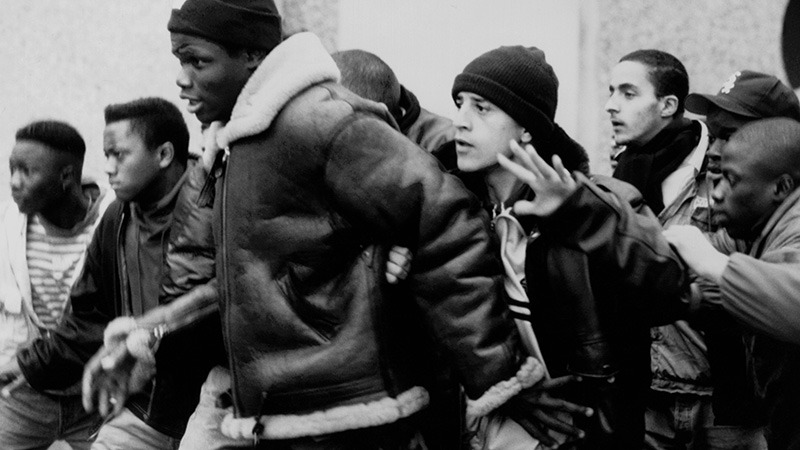
 Cinematography of “La Haine” (1995)
Cinematographer: Pierre Aïm
Nominated for the 1996 César Award for Best Cinematography
Nominated for the 1996 César Award for Best Cinematography


